Cork: Naturally High-Performing

Sustainability and technical performance can go hand in hand. Cork and cork-based composites offer the distinctive properties of a natural, renewable raw material while meeting the requirements of modern engineering applications.

Cork is the outer bark of the cork oak, Quercus suber L. The tree is not cut down during harvesting. The bark is harvested using proper techniques, then regenerates and can be harvested repeatedly throughout the tree’s life. Cork oaks have an average lifespan of around 200 years.

Frequently Asked Questions

Cork is a natural, renewable raw material. Only the outer bark of the cork oak is removed during harvesting, without cutting down the tree. Harvests are typically spaced about nine years apart, allowing the same tree to supply cork repeatedly over many decades.

Thanks to its exceptional cellular structure, cork combines low weight with elasticity, compressibility, thermal and acoustic insulation, and low permeability to liquids and gases. Combining it with different binders makes it possible to develop high-performance engineering composites.

Cork oak forests are natural carbon sinks. According to the underlying research, cork oak forests can sequester up to 73 metric tons of CO₂ for every metric ton of cork produced. The CO₂ sequestered by the cork oak forest must be distinguished from the full carbon footprint of a specific component.

Yes. Cork is combined with elastomers such as NBR, SBR, or silicone to create cork-elastomer materials for engineering applications, particularly flat gaskets for static sealing applications. Material selection depends on temperature, the service medium, mechanical loads, and other application requirements.

SCHLÖSSER manufactures custom gaskets and technical components from materials suitable for die cutting and other cutting processes. Depending on the material, geometry, and production volume, manufacturing methods may include die cutting, waterjet cutting, or laser cutting. Adhesive-backed options and custom supply formats are also possible.

Cork as an Engineering Material

Cork’s unique cellular structure makes it particularly interesting for engineering applications. One cubic centimeter of cork contains approximately 40 million microscopic cells. This honeycomb-like structure, with its gas-filled cavities, provides a distinctive combination of low weight, elasticity, and compressibility.

Cork’s natural properties make it a versatile base material for engineering applications:

Elastic and compressible: Cork can absorb mechanical loads and conform to different surfaces.

Lightweight: Its cellular structure gives it a relatively low density.

Insulating: Cork provides good thermal and acoustic insulation.

Vibration damping: The material’s structure is suited to absorbing and reducing vibration.

Low permeability: Its closed-cell structure provides low permeability to liquids and gases.

Versatile: Combining cork with suitable elastomers produces materials for a range of temperatures, service media, and load conditions.

Capturing CO₂ Naturally

Cork oak forests make an important contribution to natural carbon sequestration. As they grow, cork oaks absorb CO₂ from the atmosphere and store carbon in their biomass.

According to the available research, cork oak forests can sequester up to 73 metric tons of CO₂ for every metric ton of cork produced.

1 metric ton of cork

up to 73 metric tons of CO₂ sequestered*

*This figure refers to the CO₂ sequestered by the cork oak forest per metric ton of cork produced. The actual carbon footprint of a component made from cork must be assessed over its entire product life cycle.

A Raw Material That Grows Back

The cork oak is not cut down when cork is harvested. Only the outer bark is removed, and it then regenerates naturally.

On average, the first cork harvest takes place when the tree is about 25 years old. After that, the bark can be harvested again approximately every nine years. With an average lifespan of around 200 years, a cork oak can therefore remain a source of raw material for many decades.

Cork therefore combines the long-term use of a natural resource with attractive technical properties.

Cork Composites: Nature Meets Technical Performance

For demanding engineering applications, cork is combined with other materials. Blending it with NBR, SBR, silicone, or other polymer binders, for example, produces cork composites whose properties can be tailored to specific applications.

Depending on the material formulation, solutions are available for different operating conditions, including contact with:

  • Oils

  • Fuels and biofuels

  • Coolants

  • Gases

  • Insulating oils

Not every cork composite is suitable for every medium or temperature. The material formulation must be matched to the specific application.

Cork for Gaskets

Cork composites are particularly well suited for flat gaskets in static sealing applications.

The material’s compressibility allows it to conform to the surfaces being sealed and compensate for factors such as surface roughness, unevenness, or variations in flange geometry. Suitable cork-elastomer materials also exhibit controlled lateral material flow under compression.

This opens up a wide range of applications, including:

  • Flat gaskets

  • Housing gaskets

  • Transformer gaskets

  • Engine and transmission applications

  • Oil and fuel systems

  • Gas fittings and gas appliances

  • Electrical and electronic applications

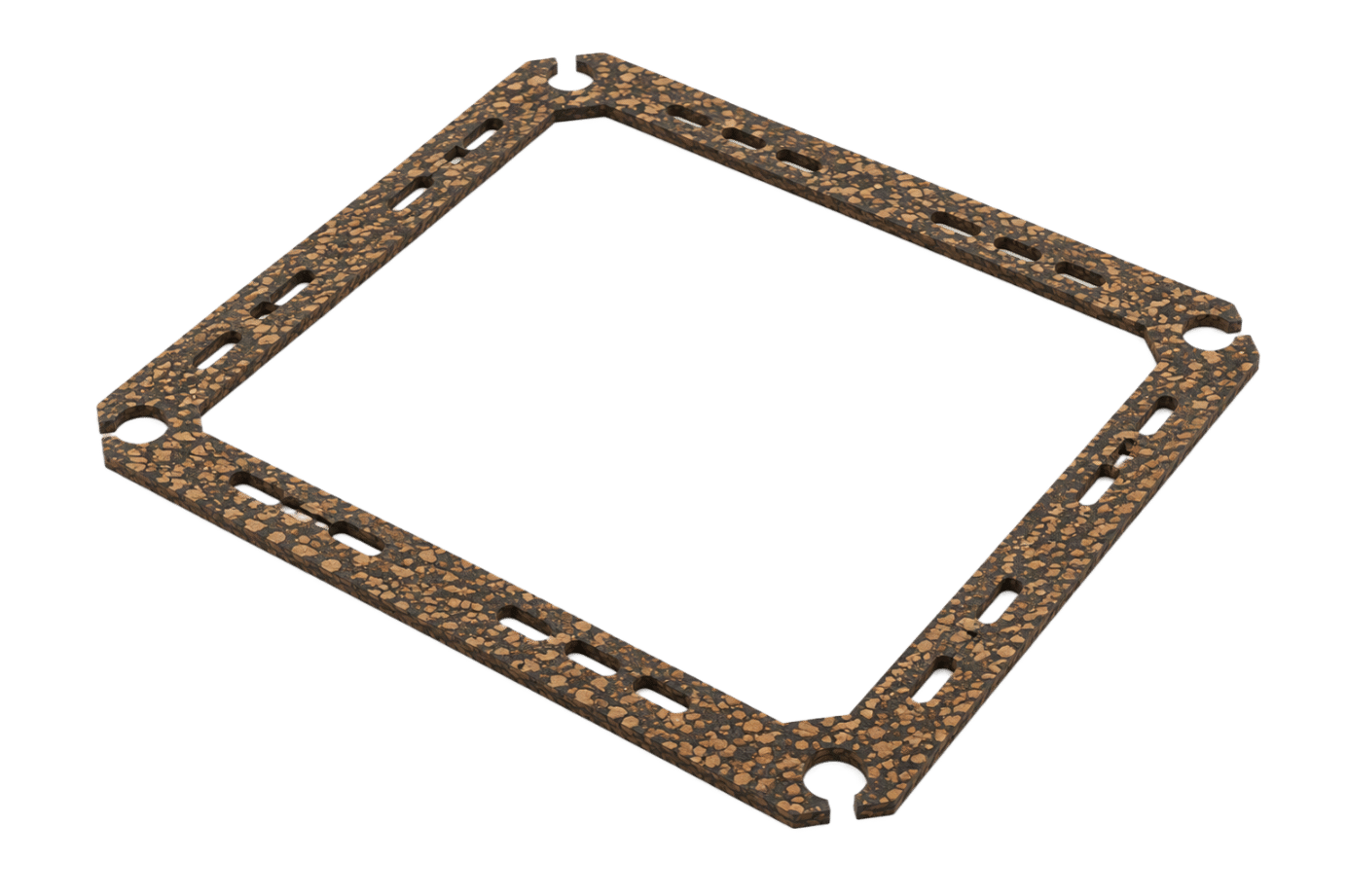
SCHLÖSSER already uses cork-rubber materials for flat gaskets.

Product visualization, partially AI-generated

Damping and Vibration Reduction

Cork does more than seal. Its distinctive cellular structure also makes cork-based composites suitable for damping and vibration control applications.

The combination of elasticity, compressibility, and damping characteristics allows the material to absorb mechanical energy and reduce the transmission of vibration between components.

Typical applications may include:

  • Machinery and equipment

  • Electric motors

  • Transformers

  • Pumps and equipment assemblies

  • Housings

  • Mounting points and bearing supports

  • Vibration-sensitive components

Cork therefore combines several technical functions that also play a central role in SCHLÖSSER’s existing range of solutions: sealing, damping, and insulating.

Schlösser GmbH & Co. KG

Wilhelmstraße 8

88512 Mengen/Germany

Ausflüge und verschiedene außen­betriebliche Aktivitäten

Unser jährlicher Outdoor-Tag ist eines der Highlights während der Ausbildung. Es erwarten dich darüber hinaus noch vielfältige Aktivitäten, wie z. B. ein Fahrsicherheitstraining, Betriebssport, gemeinsame Grillfeste und Essen, etc.

Attraktive Ausbildungs­vergütung

Unsere Bezahlung während der Ausbildungs- und Studienzeit kann sich sehen lassen. Neben einer monatlichen Vergütung erhältst du Urlaubs- und Weihnachtsgeld sowie weitere attraktive Sonderzahlungen und Prämien. Auch besondere Leistungen werden von uns belohnt – neben einer jährlichen Sonderzahlung für gute Noten erhalten Kammersieger und Jahrgangsbeste einen Sonderurlaubstag sowie Eintrittskarten für den Europapark in Rust.


Familiäres Betriebs­klima

Bei uns wird FAMILIE großgeschrieben. Wir leben einen kollegialen und freundschaftlichen Umgang, gegenseitigen Respekt und Wertschätzung sowie Hilfsbereitschaft – unabhängig jeglicher Hierarchieebenen. Bei uns gehörst du von Anfang an dazu.


deine perspektive bei schlösser

Während deiner Ausbildung- und Studienzeit geben wir dir die Chance, dich zielgerichtet zu entwickeln – für Positionen die deinen Stärken am besten entsprechen. Nach Beendigung deiner Ausbildung bzw. deines Studiums ist dein Weg bei uns noch lange nicht zu Ende. Schließt du deine Ausbildung bzw. dein duales Studium erfolgreich ab und zeigst auch in den Fachabteilungen gute Leistungen, möchten wir dich im Anschluss in einer Fach- oder Führungsfunktion übernehmen.

Vergünstigungen in unserer BeTriebskantine

Belegte Brötchen, Müsli, Wurstsalate, frische Salate und warme Speisen – die Auswahl in unserer Betriebskantine ist nahezu unbegrenzt. Mit einem großzügigen Arbeitgeberzuschuss sind die Preise besonders attraktiv.


Kompetente Ansprech­partner in den Fach­abteilungen

Du wirst in den einzelnen Fachabteilungen von kompetenten Mitarbeitenden betreut, die täglich ihr Bestes geben, um unsere Auszubildenden und Studierenden zu qualifizieren. Deine individuelle Betreuung wird ergänzt durch einen persönlichen Paten und deine Ausbilder.